
How is AI improving our healthcare? Making our travel and transportation safer? Securing our banking? Protecting our food supply? When AI policy is being discussed, these are the questions that must be asked. This is the right place to get answers.
Explore some of the ways deployers are responsibly putting AI to work to improve the products and services Americans rely on every day.
Member Use Cases
-

FedEx’s AI tools make its services easier and more transparent for both businesses and customers. FedEx Tracking+ and FedEx Returns+ add an AI-powered layer to a retailer’s tracking and returns, instantly answering common questions and catching problems before a customer has to reach out. For businesses shipping sensitive or time-sensitive freight, FedEx Surround uses AI-powered monitoring to flag potential disruptions in near real time, so FedEx experts can optimize a shipment route before it becomes a bigger problem. That’s how FedEx uses AI to get shipments delivered on time.

-

AI and virtualization are creating a new operating system for vehicle development. GM’s tools help engineers simulate aerodynamics and structural performance, design parts virtually, and identify issues earlier – accelerating development, reducing rework and avoiding costly teardowns. On the customer side, OnStar AI Assistant will debut in the 2027 Cadillac LYRIQ through an OTA update, helping drivers understand vehicle status, manage controls, and get personalized guidance – complemented by trusted human support. GM is also working to bring autonomous highway driving to customers in 2028, starting with the Cadillac ESCALADE IQ and expanding to SUVs and trucks.

-
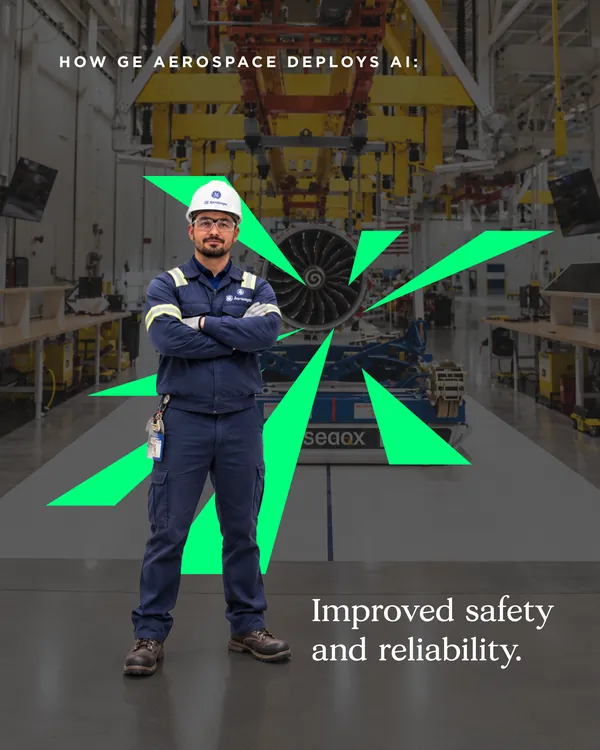
GE Aerospace uses AI to accelerate breakthrough engine designs, while more efficiently manufacturing and maintaining engines. AI tools allow engineers to explore hundreds of design concepts in seconds rather than months. An AI Engineering Assistant is reducing thousands of hours in the evaluation process for faster, more reliable part quality checks in manufacturing. To improve maintenance, an AI-guided blade inspection tool gives technicians a second set of eyes, improving inspection quality, while cutting the process time in half to return engines safely back to service faster.

-

Pfizer’s responsible use of AI tools super-charges the work of our scientists to discover, develop, and test potential new medicines. In early-stage research, these tools accelerate the way our researchers evaluate and prioritize promising molecules for further investigation. Before a compound enters clinical trials, AI tools enhance our scientists’ analysis of data to inform the design of more targeted clinical studies. If science is a vehicle, AI is the fuel and scientists are the drivers.

-

Building on its operational expertise, United uses AI-powered tools to make travel easier, giving customers clearer information and support when they need it most. The ConnectionSaver tool is a perfect example, automatically identifying departing flights that could be held for connecting customers without delaying the on-time arrival of the customers already on board. Since its launch, ConnectionSaver has helped save more than 4.7 million customer connections, demonstrating how AI can help customers reach their destinations while supporting efficient airline operations.